Wednesday, 12 September 2018

Crypto wallet

Crypto wallet

Private banks have made enormous progress at improving technologies for our convenience such as online banking, easy payments, etc. What does it matter if our money is not in our pockets, but in a bank?
Image result for wallet
Does it even matter that it is not even money, but a credit (called currency) lent to the bank? What we want is convenience and ease-of-use.

The security of the monetary system is hardly our responsibility.


However the current monetary system is destroying our economies with debt, interest payments, inflation, and derivatives, all adding up to a crushing invisible tax on productive people.

In order to continue transacting and saving in a monetary disaster (happens every 40 years or so, and currently overdue), we need a ready-made alternative money.

We could say carry gold and silver around for savings and payments, since they might have been generally accepted through common consent and attractiveness. (Could just as easily have been durable food). But stacking gold/silver coins returns to inconveniences of portability, security, and acceptance.

The inconvenience of transporting the money to make payments soon led to entrepreneurs (goldsmiths) storing the money and issuing portable bills. In the 1944 Breton Woods agreement the US would issue paper and electronic dollars representing (backed by) the gold in their safes (bounty from the war).

As expected, it was not long before printing of dollars exceeded the gold supply, and even coinage lost its precious metal content. Since 1971 in the US, and about 1973 in most other democracies, currency became completely fiat, backed by nothing but the coercion of tax authorities.

Among some recent efforts ingenious initiatives are those that store your precious metals in a vault and issue a electronic coins for your convenience to pay with (by transferring ownership of the gold/silver in the vault).

Crypto coins replace the vault with a blockchain, where owners hold the keys to their coins in their wallets (representing ownership on the blockchain).

Banks and bureaucracies have made using gold/silver and cryptos almost impossible by throttling acquisition. Besides to purchase these (crypto- or precious coins) one needs to have fiat to start with (converting a convenient currency to an inconvenient coin). Even in a doomsday scenario, it is the very fiat that will fail, and thus be worthless to purchase coins.

Furthermore blockchains and safes are still centralised and remote. Yes, vaults and crypto miners can be distributed, but your money is still not in your pocket (wallet). Vaults and miners cannot be downsized to mobile devices. Level two (off-blockchain) proposals still carry the entire network and all transactions at each node.

Even if electronic, it is still a derivative representing a coin in a vault or blockchain somewhere else.
To summarise, the following stumbling blocks are raised:
  1. Difficulty onboarding (obtaining coins),
  2. Still not having your money in your pocket
  3. Inconvenience of payments

1. Onboarding

Currently acquisition of crypto- or precious coins are dependent on:
  1. Fiat currency to purchase the coin (or mining rig), and
  2. Permission from banks and governments.
Whereas a crypto credit on the strength of production capacity (the tried and proven credit scores banks use) is created exactly as banks create loans. The crypto credit supply is thus simply tradable IOUs created when a vendor accepts payment.

The amount of credit and the terms a vendor will accept depends on the credit score of the trading partner.

Thus participants are free of fiat and permission. (Crypto credit is of course still obtainable with fiat, crypto- or precious coin as well)

2. Wallet

Having your money in your pocket is like carry a coin purse under your control and ownership. That means you are not dependant on a government (currency), bank, a blockchain, or vault, to make a payment.

However it quickly raises the question of security. Unlike physical gold/silver coins that can be stolen, modern crypto wallets typically have two factor authentication and easy online backup, making theft or loss of a device irrelevant.

The different between this proposal and an electronic wallet carrying a key to a coin in a vault or blockchain, is that there is no vault or blockchain. The independent wallets are thus lightweight enough to run on mobile devices.

It is like having physical coins securely in your possession.

3. Convenience

Payments would simply take place over any of the means of communication commonly available such as NFC, SMS, HTTP, etc., and making use of the myriad of services (APIs) already available for conversions, pricing, barcodes, etc.

Solution

The solution proposed is an independent mobile wallet; independent of banks, vaults, blockchains, and level-two’s, (even of other wallets) that contains local transactions.

Partners are identified when a transaction is to take place, and mutual interrogation (for credit rating, for eg.) is private. Just as a stolen wallet cannot be accessed, so the credit score of a personal wallet cannot be altered by the owner.

In order to promote acceptance, in competition with banks, it will need to make payments easier than contemporaries. In some countries there is still a window of opportunity before banks get on board with the tools already in use in East Asia.

Flexible terms (with each transaction) can make it attractive for vendors to accept crypto credit at a premium, or as part payment

Wednesday, 29 August 2018

National debt, inflation, and taxes

The argument for banks managing our money was that politicians could not be trusted to not inflate the currency for spending on influence.


So how well do the banks do by comparison?

Wednesday, 4 July 2018

Self-funding (bank-free currency)

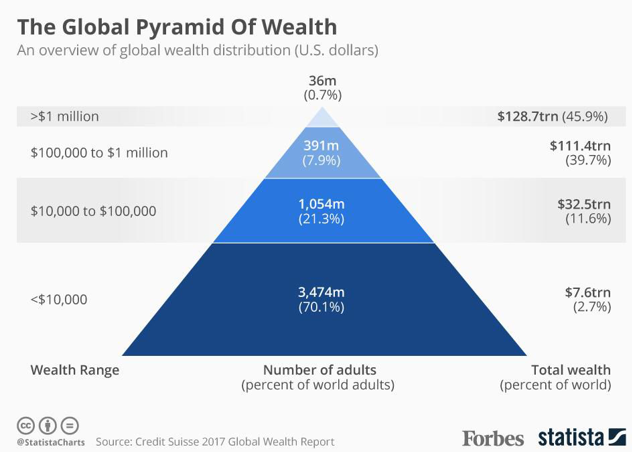
We are painfully aware of the severely distorted distribution of wealth on our planet, and how it came about.

Global wealth distribution pyramid


But what can we do about it?

Tuesday, 12 June 2018

How to pay for Universal Basic Income

The merits of UBI are obvious, so this essay will focus on how to pay for it.

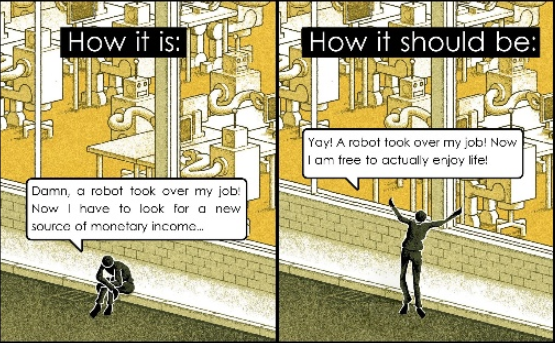
free to enjoy life

A public central bank will provide UBI for everyone. Here is the proof…


While welfare penalises participation in the economy, with UBI one is free to take a job or create your own products or services without having your UBI clawed back.

This has proven to lead to a renaissance of ingenuity and creativity, rather than the disgrace and discouragement of welfare.

plan_negocios[1]


OK, here are the numbers !!

Taking the Canadian population of 30 million as the example, then if every adult received $12,000 per year that would amount to 360 billion.

Since private banks create Canadian dollars out of nothing, then so can the government as was the case prior to 1973 by the Banque du Canada, saving interest payments of 60 billion.

The public Banque du Canada would need to introduce new currency as the economy grows to maintain price stability. Assuming a growth rate of 2% on a GDP of 1.5 trillion that amounts to 300 billion.

To sum up (in billions)
(360) – Universal Basic Income
60 – Interest payments
300 – Price stabilisation

This $360 billion is created by the country anyway.
It is up to us to decide whether it
  • goes to private banks (the very mechanism by which the rich become richer at our expense) or
  • comes to the people (who produce it).

Please support COMER and IMMR and to return to a democratically managed currency as it was prior to 1973.

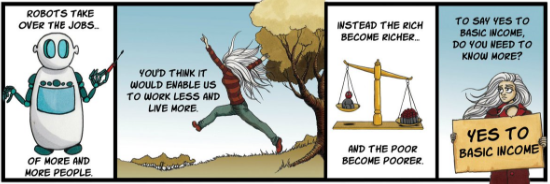
Basic income is a necessity

yes to basic income

How to pay for Universal Basic Income

Friday, 8 June 2018

Invisible tax


Inflation is an invisible tax on wages and savings.

The purchasing power of new currency comes from the dilution of our wages and savings.

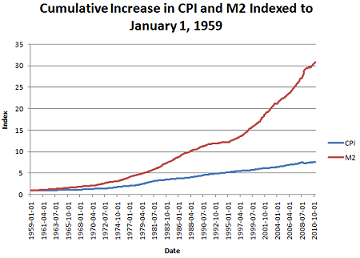
Cumulative increase in CPI and M2 small


But the inflation of the currency supply is far greater than we think.

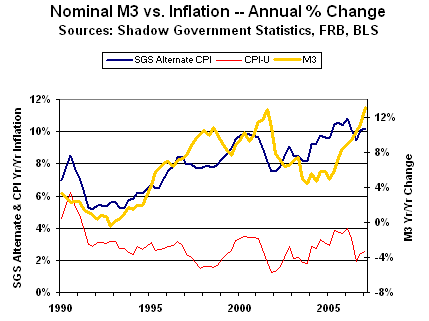
We all understand that the increase in consumer prices on the shelves (CPI) erodes our purchasing power, but the real inflation rate is much higher. It is the rate at which the currency is actually increasing.

Inflation rates M3 CPI

This real rate of erosion is hidden by our productivity (more work, more throughput, more production, with that same inputs) that makes the difference between CPI and M2/3. We work harder and smarter to keep inflation down, but the benefits do not accrue to us, but rather to the currency creators.

This tax accrues to banks.

The inflation of currency also explains the long term increase in stock prices, since that is where much of it ends up, buying up control of listed companies with created currency.

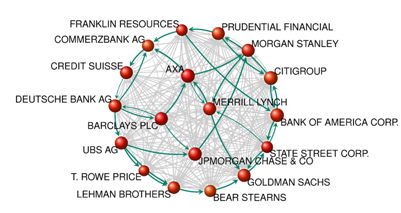
network of global corporate control

The Network of Global Corporate Control clearly shows the beneficiaries of this bounty of invisible tax on our savings and wages. This currency is created out of nothing, issued as debt at interest.
Note that these loans are claims on our assets, and that bankruptcies lead to the expropriation of those assets.

Also note that the interest to be paid is not also created, thus interest payments come out of the existing currency supply (loans). This inevitably leads to reduction in currency supply, busts, and bankruptcies.

Governments have to keep borrowing more and more just to make those interest payments, eventually forfeiting pensions, gold reserves, land, and infrastructure to restructuring and austerity. The largest single expenditure at all levels of all governments is interest payments. Governments tax us to pay banks.

Governments are simply another type of organisation such as the Vatican, or General Motors. While GM sells motorcars and the Vatican sells hope for their income, governments extort their income through tax agencies, courts, police, and incarceration, ie., the largest government agencies exist for coercion. (If government services were valuable, they could sell them)

Likewise, corporations have to keep growing, churning, and externalising costs onto labour and the environment to pay for financing. This system needs new wars (another large government agency) or corporate capitalism dies. Government- and corporate machinery is devastating us and the earth in service of banks and bureaucracies.

It is access to this volcano of currency that empowers a small group to run corporations, bribe politicians, grease bureaucrats, influence courts, pollute our planet, dispossess and enslave humanity, and cause wars (the grandest of thefts).

They suck the life out of governments, corporations, and individuals through interest and dispossession, while taking control of them through equity, bribery, and destitution.

While we cannot fight them, we will make them obsolete and irrelevant.

Invisible tax

Friday, 26 January 2018

Free money alternatives

We have been trained to accept that capital comes from savings. Savers are paid interest, and lenders are charged a little higher rate to cover expenses, and hopefully make a small profit in the end.
Well, we now know this is not the case...

Thursday, 30 November 2017

Removing the constraint of currency for full employment


It is common knowledge that banks do not lend out savings, but rather create money out of nothing when a contract is signed.

For example, the currency (account balances) for a mortgage does not exist until the contract is signed. Then a bookkeeping entry gives the bank an asset and the borrower a liability.

This newly created currency can then be used to purchase a house, materials, contractors, etc.
But there's a catch ...

Friday, 24 November 2017

The magic of money

The magic of money

Once upon a time a little village had merchants such as the baker and brewer who provided bread and beer to the carpenter and farmer, knowing that in exchange the carpenter kept the furniture and fittings in order, while the farmer supplied grain at harvest time.

Friday afternoons in the pub they often pondered on how to trade with the village up the slope for grapes and wine, and the village downstream for beef and milk. The dilemma was coinciding the availability of products to barter, for eg., milk was available daily while wheat could be offered only at harvest time.

It would be difficult to establish the required trust to settle what is owed with strangers, or even neighbours who were not friends or family. So trade was stalled.

One Friday afternoon (in the pub again), a smartly-dressed sorcerer entered and offered a solution to the trade impasse. He opened his hand to reveal gems so attractive that everyone desired some. He said they were made from moonlight through a sacred process only sorcerers possessed, and called them moondrops.

He explained that since moondrops were universally sought after, they could be used purchase wine milk from neighbours at any time. The villagers immediately saw the utility of moondrops and agreed to secure a supply to trade with, by pledging their common land as collateral.

Trade expanded rapidly. The villagers enjoyed exotic foreign products such as milk, beef, grapes, and wine, while neighbours acquired a taste for bread and beer.

Almost unnoticeable, moondrops seemed to evaporate slowly. In order to maintain the level of trade, the supply of moondrops needed to be maintained by further pledges of assets and produce, and eventually even labour.

Inevitably, the sorcerers ended up with everything, reducing proud, skilled craftsmen and merchants to employees in their previous businesses earning just enough to feed themselves, and to keep coming back, indistinguishable from slaves.

A variation on the theme …

Instead of going to the pub, the sorcerer went to the king with promises of vast wealth through the purchasing power of moondrops secured with crown land, that the king could continue to use. What a deal eh?

Citizens could be paid with moondrops, and then use them to trade among each other, and pay taxes.
However, moondrops were hexed, and slowly drained the vitality of citizens, and production from crown lands. The citizens found themselves working harder and harder, for less and less, while being taxed more and more to maintain the strained government trying to maintain crown lands, and law-and-order among a continually impoverished citizenry.

Eventually, rundown businesses were ripe for take-overs, and undefendable land vulnerable to invasion.

Of course the drained energy accrued to the sorcerers who used this power to create floods moondrops used to buy up land and businesses, and to foment wars against those who resisted. Eventually all assets were owned by the sorcerers, and all people relegated to slavery on the lands and businesses of their parents.

Lucrative arms industries to supply law enforcement and wars, and pharmaceutical industries to supply chemicals that temporarily relieved the energy drain of moondrops arose. Owned by sorcerers these industries soon became the dominant industries on the planet.

But of course, this is all make belief …

Wednesday, 18 October 2017

The laughing lion and the doves


The laughing lion and the doves


Perhaps the ashes of the labour guilds will be the phoenix that will form the nucleus of an alternative to bureaucracies, both corporate and government.
Phoenix
There is a thin layer of capable, productive people preyed upon by pyramids of parasites, whose livelihood depends on subjugation and exploitation of those capable of wealth creation.
Parasites who live for the accolades, scraping, and homage in contempt of subordinates grovelling for leave.


This is a world where human rights and freedoms do not exist. Indeed humans are considered resources and HR departments there to enforce corporate policy on those subjects.
However, the system won’t fix itself; it will have to be replaced.

Politicians are as ineffectual as board members in bringing about change, so we will have to build institutions outside of the bureaucracies by means of cyber-market mechanisms, and even low-tech coinage, where people can participate as it suits them in competition with corporations and governments.


Consider that governments and corporations were supposed to compete for skills and capital, but since people are trapped like cattle behind fences, capital alone has distorted both government and corporations to such an extent that cabinets are seeded with banksters, and CEOs, earning 100s of times the average wage, are appointed from that layer of capital.


Who cares about voters, taxpayers, savers, and shareholders.


doves


We will have to not only make our own markets for our survival, but make them efficient enough to compete against the establishment.


But that will be easier than it might appear due to the burden of bureaucracies, that will crumble under their own incompetence once capable people have alternatives.


It’s time for the end of the reign (Ragnarök). Let the capable people (übermensch) be the lions scattering the flocks of bureaucrats.

Tuesday, 17 October 2017

Financing

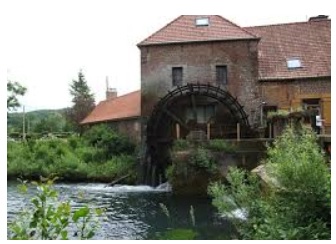
Once upon a time an entrepreneur envisaged a watermill in a village with all the resources and skills to construct one
https://www.flickr.com/photos/75894308@N03/7657361676The mill’s construction drew on forests and quarries for raw materials, and on carpenters and masons for skills, stimulating demand and thus economic activity


Once the mill was completed, the village could reduce costs of flour and products such as bread and pastries which could be sold beyond the town limits. Cereals from neighbouring towns were also milled, making the enterprise a success, and the town prosperous

Wednesday, 28 June 2017

Pay and productivity

Pay and productivity


Since 1973 there has been a divergence of pay and productivity, contributing to the massive income inequality.

What happened in 1973?

Canada is a text book example. Before 1973, under the McKenzie-King legislature (and the constitution in fact), the publicly-owned (unlike the US Reserve bank) Banque du Canada managed the currency supply.

Control of national currencies


In 1973, under Trudeau premier, the right to create currency was handed over to private banks.

What this means is that all levels of government now have to be indebted to private banks for financing in the country's own currency, which is nothing more than a legal idea, created out of nothing but bookkeeping.

Worse, interest has now to be paid on that artificial (fiat) currency or the assets covering the debt (pension funds, infrastructure, buildings, land) will be seized. It is important to realise that the currency for the interest payments has not been "created", thus it has to be extorted from taxpayers.

An ever increasing percentage of government budgets (the largest single item) is paid to banks as interest for no reciprocal performance. Remember this budget is real effort and assets of taxpayer being handed over.

Money that should have been available for infrastructure.

Quantitative easing


Secondly, this free hand at creating currency has lead to an "exuberant" inflation of currency by the banks in the name of easing, bailouts, etc. (While the US's initial 2008 bank bailout was $760 billion, Canada's was $200 billion). This is simply the taxpayer being placed on-the-hook, under threat of foreclosure, for rampant currency creation, ie., debt.

Each new dollar created of course has purchasing power. This value does not come from the "printing press", but robbed from savings and wages through inflation (more units makes each existing unit less valuable).

Rate of impoverishment


We can only guess at the rates, but less say the inflation of the currency supply (it is parabolic) is about 12% per annum, and the inflation of consumer prices is about 2% (with food and fuel, perhaps 4%).

The difference of 8-10% per year is the rate at which productivity is being stolen from the producers.
Image result for inflation of money supply consumer prices graph OR chart

Permit me a word on bankruptcies please. Bankruptcy does not mean "cleaning the slate"; bankruptcy means handing over your assets, ie., dispossession.

Bankruptcy is important because the bookkeeping trick requires that interest be paid out of the existing currency supply (loans/debt), thus reducing the currency supply forcing governments to perpetually borrow more just to maintain the currency supply and prevent deflation, and economic shrinking.

Every debt covenant has an asset attached, pension fund, infrastructure, land, etc.

This continual interest payments on our own currencies, requiring more debt to maintain the currency supply will inevitably lead to bankruptcy.

Dispossession of national assets


This simple bookkeeping scam, legislated in 1973, has lead to a volcano of new currency,
  • debasing our saving and wages, and
  • since currency is now debt, leading to bankruptcy and dispossession of national assets
This is why banks continue to lend to governments who have no hope of repayment, since they are after the real assets such as pensions, land, and infrastructure, not repayment of currency created out of nothing

Thursday, 1 June 2017

Usury, debt, interest

Usury, debt, interest


Deuteronomy 23:20
You may charge a foreigner interest, but you may not charge your brother interest, that the LORD your God may bless you in all that you undertake in the land that you are entering to take possession of it.

DISPOSSESSION is the essence of issuing currency as debt at interest.

In an organic monetary system, governments create interest-free currency (as was the case in most democracies prior to 1973), and spends it into circulation via the budget. This was typically done by government-owned, central banks (such as Canada, but unlike the US where the fed is private). Commercial banks are agents of this money, not creators.

Currently all currencies are created the out of nothing by commercial (private) banks in exchange for a mortgage (death pledge) or collateral, issued as debt at interest.

For eg., someone approaches a bank for a loan. The bank does not retrieve the amount from the safe, but creates it out of nothing the minute it has a lien on property or enslaved the labour of the applicant. Suddenly the bank is in possession of an asset and interest income, where a moment before it had nothing.

The same applies to governments who forfeit pensions, land, and infrastructure.

This volcano of new currency, inflates the money supply (not inflation of prices) at the expense of savings and wages, which decrease in value as a result of this inflation.

Since the currency for the interest payments is not created with the loan, there is a drain on the currency supply to pay interest, inevitably leading to bankruptcies, ie., dispossession.

This is also the reason all governments are in more and more debt, since they cannot pay off the loans without exhausting the currency supply leading to economic stagnation and bankruptcies.

Exodus 22:25
If you lend money to my people ... you shall not exact interest from them

Tuesday, 23 May 2017

The US depends on Saudi Arabia for survival

The US depends on Saudi Arabia


If Arabia accepts Euros (like Saddam), or gold (like Muammar) for oil, the US would go bankrupt.

How does that work?

If another country needs to purchase oil they can only do so with US dollars (petrodollars).

That means that they have to produce something for the supermarket shelves or arms industry in the US in order to obtain US currency. This is often done below cost due to competition from other countries who also need US dollars for oil purchases and international trade.

Now, should there be no need for US currency for oil purchases the demand for dollars will disappear meaning:
  • Anyone with USD will be scrambling to purchase anything that can be bought with USDs leading to massive inflation in the US
  • Items on store shelves that were previously paid for with "paper" will now be unobtainable, or at least at a fair price
  • The US will be denied their usual way of paying for imports and will thus suffer from a balance of payment deficit leading to further declines in the dollar exchange rate
  • Prices of imported items will increase as a result of the declining exchange rate
  • Assets in the US will become available to foreigners at bargain prices
How much longer can the Bretton Woods USD hegemony survive?

Sunday, 21 May 2017

Recessions accelerate dispossession

Recessions accelerate dispossession

We need to grasp that recessions are a totally artificial manipulation of currency credit to cause bankruptcies and dispossession of property and enslavement of labour


It is our duty to free ourselves

It is our duty to free ourselves


If a soldier is imprisoned by the enemy, don’t we consider it his duty to escape?. . .If we value the freedom of mind and soul, if we’re partisans of liberty, then it’s our plain duty to escape, and to take as many people with us as we can!”
― J.R.R. Tolkien


Do not use this money to pile up needless junk you don’t need. Use it to build your catapult. The one which will launch you over the walls of the corporate prison. Money gives you leverage. Build enough leverage, and you can pretty much do whatever you want all the time.


Sunday, 14 May 2017

Living tax free

As long as we a taxed, we are not free.
This site will demonstrate how to have good governance without tax.
Consider that before:
  • 1973 government paid no interest (currently the largest expense in the budget)
  • 1914 we paid no income tax